


Older (Summer 2013) - Newer (Winter 2014)
Fall 2013 Newsletter
Volume 10; Issue 4

Market Watch
Stock and bond markets faltered a bit towards the end of June as investors had a bit of “taper tantrum”…worrying when the Federal Reserve in the US would begin to “taper”; in other words when they would begin to remove the stimulus that has helped boost the economy, and what impact that might have. Also, the threat of rising interest rates caused bonds to fall in value and stocks felt the pinch also. Interest rate sensitive stocks, typically more defensive, were hit especially hard. Markets recovered nicely from this small pullback in June and so far returns have been buoyant year to date. The US in particular has delivered very strong returns, and European stocks, while less heralded, have also enjoyed a healthy run up. Canada has continued the trend of the last few years of relative under-performance as commodity prices have continued to be weak and commodity stocks even weaker, but some managers feel that 2014 could see stronger returns for Canadian stocks. The Emerging Markets have been flat to negative for the year, despite strong growth in these economies. Improved fundamentals in the US and Europe have caused many investors to pull out of the developing world but this is likely not a long term trend given strong long term trends driven by demographics and high levels of growth. Overall 2013 is shaping up to be a decent year for investors and while the volatility has only lessened somewhat, the trend has generally been upward.
So looking towards the end of 2013 and into 2014, I think we can remain cautiously optimistic. There are many things to still be cautious about, and the path forward will likely not be smooth for some time. Despite headwinds from government debt in the developed world, the global economy is still growing and the middle class globally continues to expand. It is important to be diversified and not try to chase, or flee from, recent performance trends and always remember to take headline and dire predictions with a grain of salt. Headlines towards the end of 2012 were warning of a pending US recession, driven by budget cuts. Investors who moved to the sidelines in a meaningful way missed out on a nearly 20% gain in the US market in the first 9 months of this year.
In light of all the moving parts that make up today’s investment landscape, I feel very confident with the current positioning of the fund managers I have selected to manage my client’s assets. If you have any questions or concerns, I’d be happy to discuss your portfolio at any time.

Registered Disability Savings Plans (RDSP)
RDSPs were introduced by our federal government in 2008 and the benefits are just too great to ignore. They were designed to help people with disabilities save for their future and offer wonderful government incentives.
In order to be eligible to open an RDSP, you must be eligible for the disability tax credit, be a Canadian citizen, have a valid Social Insurance Number, and be under the age of 60.
The main advantages are as follows:
- Contributions grow tax-free until the money is taken out of the plan
- These plans may be eligible for government incentives in the form of grants up to $3,500 annually with a $70,000 maximum lifetime grant amount
- When it comes time to take the money out of these plans, income payment do not affect other government programs such as OAS, CPP, GIS, and other social assistance programs
Eligibility for grants is income-tested every year. However, when looking at family income, the government looks at net income from 2 years prior. So a contribution made in 2013 would be based on the 2011 family income. Once the plan is open, owners will receive an annual letter which breaks down the maximum contribution they can make and the maximum grant they will receive to help individuals utilize this program and take advantage of catch up grants.
For example, if a family has a net income of less than $75,000 they could contribute as little as $125 a month and receive up to $3,500 in an annual grant. This could certainly add up to a lot of money over time.
If you or anyone you know would like information on RDSPs please send either Rick or myself an e-mail as we would be happy to provide more details.
Cheers, Melissa
Five Years Ago...
This fall marks the 5-year anniversary of one of the worst stock market shocks the world has seen. This time in 2008 the global economy stood on the brink in the wake of the credit collapse that followed the failure of massive US investment bank Lehman Brothers. Governments in Europe and the US had to intervene in an unprecedented way to bail out major financial institutions and prevent a wide-spread global financial meltdown. Markets have recovered significantly from the lows of early 2009 but the memory of that period is still strong in investor’s minds. Despite all of the doom and gloom in the popular press at that time, markets did stage a remarkable recovery and while Canada hasn't fully kept pace, the US and many European stock markets have already reached new highs. It wasn't easy navigating through that period of time but cooler heads, in the end, prevailed.
United States Government Shutdown
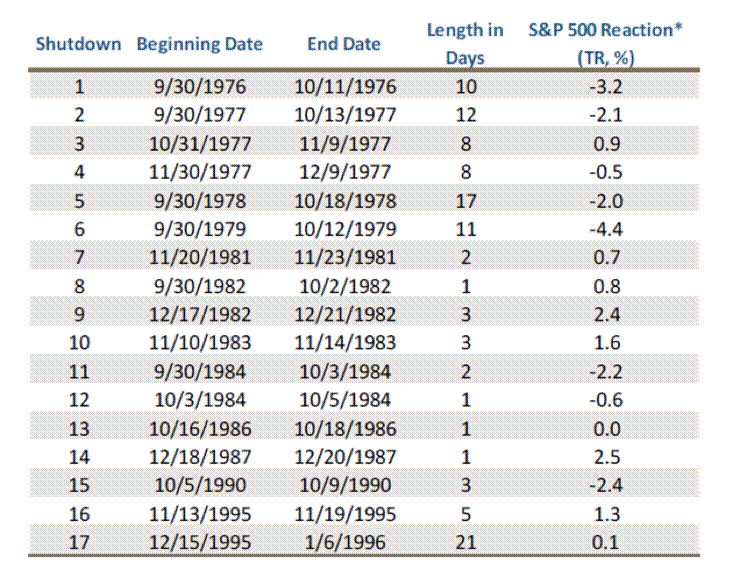
In the latest chapter of the seemingly endless drama unfolding in Washington, U.S. politicians failed yet again to reach a consensus over government spending and a large part of the U.S. government has been shut down as a result. While the rest of the world sits back and scratches its head at this on-going political theatre, it’s important to look back and see just how common these shutdowns are. In fact, the US government has shut down no less than 17 times since 1976 (not including this shutdown) with the average length of shutdown being 7 days. The longest shutdown lasted 21 days during Bill Clinton’s presidency in 1995-1996. As you can see from the chart below, courtesy of Bloomberg, the stock market doesn’t historically get all that fazed by a shutdown, usually with only marginal losses and sometimes even gains.
Of much greater importance is the pending deadline (self-imposed), yet again, on raising the debt ceiling, which is the limit on how much the US government is permitted to borrow. The date is October 17th. The last time this vote went down to the wire the major credit rating agencies took the unprecedented step of lowering the US’s credit rating. If the US government fails to come together and vote to raise the debt ceiling there is no doubt this would have an adverse effect on world markets, but it is very unlikely that they will fail to do so, given enormous consequences this could potentially have. Currently there are signs that they are slowly working together and it is very likely that they will vote to raise the US governments borrowing limit. Of course the US government debt level is a very real problem that has to be addressed…hopefully with both sides working together and not drawing lines in the sand as we have seen lately.

The Benefits of CRA Online Access
We would highly recommend registering for an account under your individual Social Insurance Number with CRA’s online services. Registering for this account will allow you to login at anytime to track both your RRSP and TFSA contribution limits in addition to other features such as viewing your tax returns, refunds, carry forward amounts, child tax benefits, etc.
It can be particularly helpful to monitor your Tax-Free Savings Account limits. As many of you know, Tax-Free Savings Accounts were established in 2009 with an annual contribution limit of $5,000. This limit was increased in 2013 to $5,500 annually and the maximum allowable contribution into a TFSA today would be $25,500 (including carry forward amounts). As of January 1st, 2014 a new $5,500 contribution will become available.
We try to monitor your contributions here but it can get complicated if you have another TFSA elsewhere or if you’re redeeming funds out of your TFSA. When you redeem from your TFSA, you have to wait until the next calendar year before the amount withdrawn is made available to re-contribute again.
Similar to RRSP’s, If at any time in the year, you contribute more than your allowable TFSA contribution room, you will be considered to be “over-contributing” and you will be subject to a tax equal to 1% of the highest excess TFSA amount in the month, for each month you are in an excess contribution position. I think it’s safe to say that no one wants to pay penalties to CRA for this so registering for online access can certainly benefit you and us when we meet to do your annual top up contributions.
In order to register you will need to have your tax return from last year as you will need to enter information from this return to authenticate yourself. Registering is an easy step-by-step process on the CRA’s secure website. Below is a link to get registered. If you have any questions or if we can help you register, please let us know!

Follow us on Twitter!
Commissions, trailing commissions, management fees and expenses all may be associated with mutual fund investments. Please read the prospectus before investing. Mutual funds are not guaranteed, their values change frequently and past performance may not be repeated.
Insurance products, including segregated fund policies are offered through Trinity Wealth Partners Inc., and Rick Irwin offers mutual funds through Quadrus Investment Services Ltd.
The information provided is based on current tax legislation and interpretations for Canadian residents and is accurate to the best of our knowledge as of the date of publication. Future changes to the tax legislation and interpretations may affect this information. This newsletter contains general information only and is intended for informational and educational purposes provided to clients of Rick Irwin, CFP, CLU. While information contained in this newsletter is believed to be reliable and accurate at the time of printing, Rick Irwin does not guarantee, represent or warrant that the information contained in this newsletter is accurate, complete, reliable, verified or error-free. This newsletter should not be taken or relied upon as providing legal, accounting or tax advice. Prospective investors should review the offering documents relating to any investment carefully before making an investment decision and should ask their advisor for advice based on their specific circumstances. You should obtain your own personal and independent professional advice, from your lawyer and/or accountant, to take into account your particular circumstances. Quadrus Investment Services Ltd. and design, Quadrus Group of Funds and Fusion are trademarks of Quadrus Investment Services Ltd. Used with permission.